
In the year between the first Seattle fast food strikes and the passage Seattle’s landmark $15 minimum wage law, we heard all kinds of of sky-is-falling predictions from business owners, academics, and others. Week after week, self-appointed experts showed up in the news, insisting that they knew best. It was Economics 101, they’d say: higher wages would surely sink the economy. Businesses would be destroyed. Franchises would cease to exist. Prices would rise 25% or more. Open for business signs would go dark, owners would move to Texas, and Seattle would become a city of Cheesecake Factories.
Their arguments are pretty much the same stuff as business lobbyists have been saying since child labor laws were passed. And yet they were treated as credible sources in Seattle’s public debate.
Now, a year after Seattle’s $15 minimum wage was signed into law — as cities across the state and across the country move to pass $15/hour laws of their own — it’s time to take a look at how those predictions are holding up.
Spoiler alert: the sky remains aloft.

Chuck Stempler of Alphagraphics is a named plaintiff in the lawsuit by the franchise industry arguing that Seattle's $15 law is unfair to McDonald's. He told KOMO news jobs & businesses will be lost because of the law... at the same time he's hiring and his business is up 9% over last year.

From Howard Schultz of Starbucks to Tim Worstall of Forbes to the Seattle Times Editorial Board, all kinds of self-appointed experts repeatedly insisted that they had expert insight into the consequences of a $15 wage in Seattle. A year later, their predictions have turned out about as well as anything else from Chicken Little. The sky remains aloft.

The owner of local burger chain Dick’s Drive-In, the granddaughter of the founder, argued that a $15 wage would have serious consequences for workers and customers. Now, Dick’s said it won't raise prices after all, and they continue to provide scholarships & benefits as they have done for some time.

Seattle Times columnist Thanh Tan wrote that the best way to measure the impact of the $15 minimum wage would be to look at pho restaurants — whose owners, she argued, could not likely afford higher wages or higher prices. Four places selling pho have opened since then.
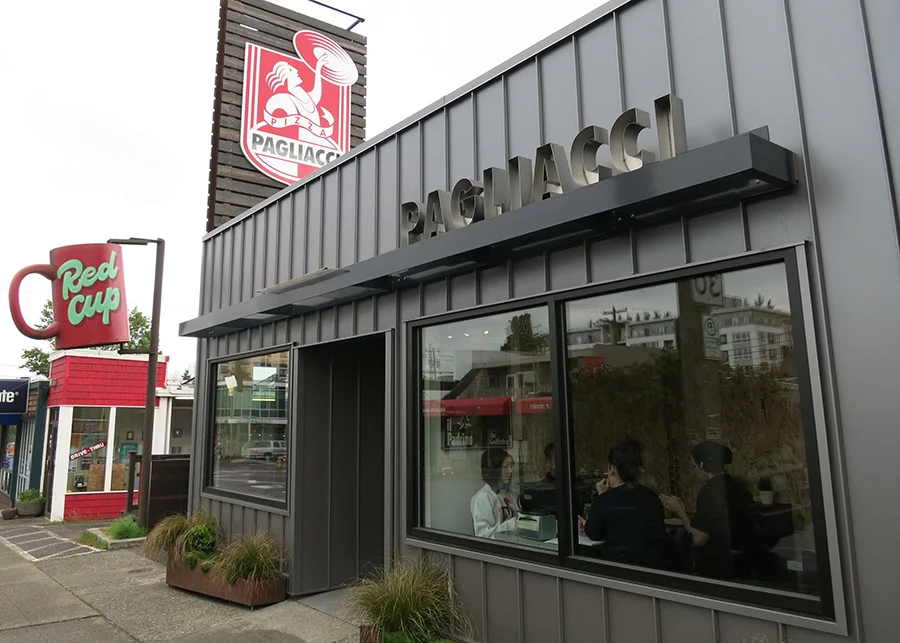
Matt Galvin, the owner of Pagliacci Pizza made a couple comments about tips and business locations which are often cited in attacks on our minimum wage law. Since the law passed, they continue to do business in Seattle, even expanding and hiring aggressively in the city.

Angela & Ethan Stowell repeatedly predicted grave consequences would fall upon Seattle restaurants if the minimum wage rose to $15/hour. Now they've announced plans to open three new restaurants in the city.

Owners of Subway stores have spoken out repeatedly against Seattle’s $15 minimum wage law, making all kinds of predictions about business closures and cost increases. They're even supporting the lawsuit to overturn Seattle's $15 law. But since the first wage increase took effect, Subways are expanding, barely raising prices, and hiring on the basis of their high wages.

Tom Douglas vociferously opposed the $15 minimum wage law, as he opposed Seattle’s paid sick days law a few years earlier. His 18th Seattle restaurant is set to open July 1st — after he opened 5 others since 2013.

Jeremy Hardy is an experienced restauranteur who contributed to the Forward Seattle effort to repeal Seattle’s $15 minimum wage law and argued repeatedly in support of a sub-minimum wage loophole for employees who receive tips. He has opened two new restaurants in Seattle since he began predicting imminent disaster.

Jerry Traunfeld said a $15 minimum wage would not be possible without a tip credit. He's now opening a second restaurant next door to his first.

Ron Oh is a Holiday Inn Express franchisee in North Seattle who joined the franchise lobby’s lawsuit to overturn Seattle’s $15 law, arguing that paying higher wages more quickly is unfair to giant national chains. He was already making good profits, and he's still hiring.
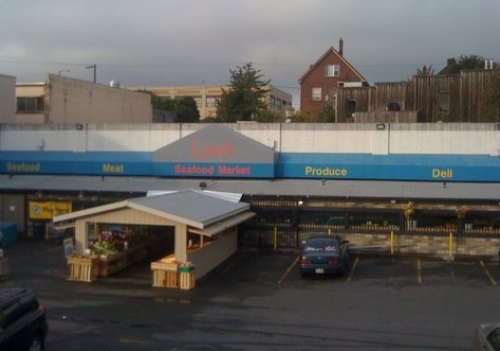
Owner Yen Lam-Steward helped organize a business coalition that opposed the wage increase and then contributed to the effort to repeal the law by referendum. Despite threats, business apparently remains strong in Seattle — they're now expanding parking.

Andrew Friedman was one of the most outspoken opponents of Seattle’s $15 minimum wage law, and helped lead the fringe Forward Seattle effort to repeal the law. His second bar is set to open any day now.