A citywide map of every burger chain outlet affected by the boycott is available here.
New poll shows 71% of Capitol Hill and other City Council District 3 voters back $15 minimum wage; workers here call for boycott 2/20
A citywide map of every burger chain outlet affected by the boycott is available here.
New poll shows 74% of South Seattle and other City Council District 2 voters back $15 minimum wage; workers here call for boycott 2/20
* McDonald's - SoDo * McDonald's - Graham * McDonald's - Rainier Beach * McDonald's - Georgetown
A citywide map of every burger chain outlet affected by the boycott is available here.
New poll shows 58% of West Seattle and other City Council District 1 voters back $15 minimum wage; workers here call for boycott 2/20
* McDonald's - Morgan Junction * McDonald's - Westwood
A citywide map of every burger chain outlet affected by the boycott is available here.
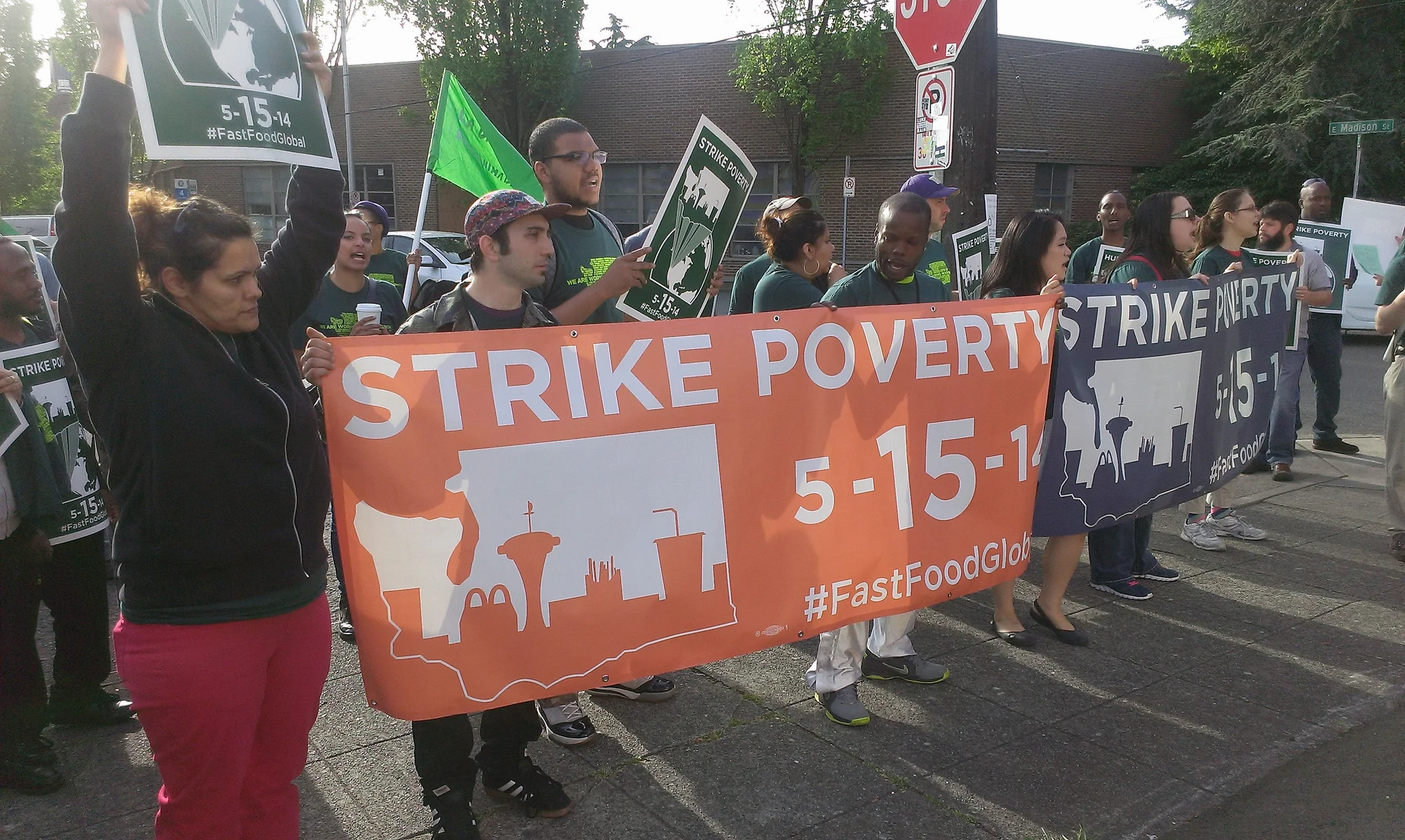
Boycott McPoverty - February 20th
The big burger chains make billions of dollars a year while paying workers less than it takes to survive. McDonald's, Burger King, and Wendy's have franchised a McPoverty business model that leaves workers unable to support themselves, shifts costs to the public, and lowers consumer demand. When workers aren't paid enough to even afford basics like food and rent, they can't build a better future, or help create prosperity in their community. McDonald's, Burger King, and Wendy's can afford to pay workers enough to support themselves & contribute to the economy. The big three chains serve billions & billions of burgers at more than 24,000 locations across the country (including 25 in Seattle), and they make billions and billions of dollars doing it. McDonald's alone banked $5.6 billion in profit just last year, with a profit margin of 20%. Even the franchised stores in these chains are typically owned by large and profitable corporations that control hundreds of locations.
Fast food workers are calling on Seattle to Boycott McPoverty on February 20th. The mass citywide boycott will call on the big burger chains will to lead by example and implement a $15 wage that transforms McPoverty into middle-out prosperity. Higher pay is good for workers and good for the whole economy, because more money for more people means more customers for every business out there — you can contribute a whole lot more to the economy at $15 an hour than you can at $9.32.
Join us and ask Jermaine Kearse, number 15, to stand with the 15th man!
Sample Tweets to send to Seahawks' receiver Jermaine Kearse, number 15, AKA @chopchop_15.
1. Seahawks #15 scored for Seattle and helped win the game. Think he’ll support $15 for Seattle too? @chopchop_15 #15forSeattle
2. Congrats on the well deserved victory @chopchop_15, want to help us score $15? #15forSeattle!
3. Seahawks win the Superbowl! Now let’s get @chopchop15 to help us win #15forSeattle
4. Well done @chopchop_15. How about supporting the 12th Man win $15? #15forSeattle
5. Join us and ask Jermaine Kearse, @chopchop_15, to stand with the 15th Man! #15forSeattle
6. Let’s ask number 15, Jermaine Kearse, AKA @chopchop_15 to help us win $15 for Seattle. #15forSeattle
7. Jermaine Kearse, @chopchop_15 , evaded opponents and scored for Seattle. Think he’ll support scoring $15 for Seattle too? #15forSeattle
8. Hey @chopchop_15 , what do you think about making sure the 12th man gets $15/hour? #15forSeattle
9. It’s simple numerology: Seahawks #15 Jermaine Kearse - @chopchop_15 - should support bringing a $15 wage to all Seattle? #15forSeattle
10. When #15 Jermaine Kearse scored a touchdown, Seattle cheered. Now we’re asking #15 to help us all score $15! @chopchop_15 #15forSeattle
The $15 Movement walks in MLK's footsteps
“We get discouraged a lot as black people in America,” Martina, who works at McDonald’s, said to the gathered crowd at the culminating rally of the Martin Luther King Jr Seattle March. “But, I’m going to keep pushing for a $15 minimum wage because I can’t afford to go back to school on the wage right now. I want to get my BA and get a job that helps people.”
She continued.
“All of us are out here fighting for $15,” she said. “We can make it happen, if we don’t give up.”
The 31st annual Seattle Martin Luther King Jr Day March was focused squarely on King’s fight for economic justice - in Seattle, in 2014, that means the $15 movement.
Thousands of community members marched from Garfield High School to Westlake Park all united under the theme of the day “Rise Up. Restore the Dream.” The march was a continuation of Dr. King’s fight for economic opportunity and racial justice.
On the original “March on Washington” of the ten demands the protesters brought to to DC six of the ten demands were directly related to economic justice. One of the boldest demands was for a national minimum wage “that will give all Americans a decent standard of living.” ( By the way, the demand was for $2 an hour which adjusted from 1963 dollars to 2013 dollars is roughly $15 an hour.)
The crowd grew as we marched through Capitol Hill and downtown. Banners and hand held signs dotted the crowd as community organizations from a diverse collection of labor, faith and peace activists all marched together — united. News helicopters followed and local journalists jogged on the sidewalks trying to keep up with the brisk pace down to our ending point, Westlake Park.
Carlos, a student at Seattle Community College and a fast food striker, spoke at the culminating rally in Westlake Park.
“We need to get together,” he said. “If we want to make real, lasting change, we can’t do it alone. This movement about $15 an hour is real, is concrete. It’s a first step we have to take.”
“We may have differences,” he said. “We have differences, but we are all people, we all want good jobs and a chance to take care of our families. We can do this for ourselves, for our families, for everyone!”
From faith leaders and hip hop artists to fast food workers and city councilmembers, speaker after speaker talked about the need for Seattle to pass a $15 an hour minimum wage that would benefit everyone.
Newly elected Seattle City Councilmember Kshama Sawant spoke to the crowd.
“This is more than a fight for $15,” she said. “It is about all of us, the people on the bottom, finally waking up. Let’s get out there and get this done.”
$15 movement turning out to support this year’s annual Seattle MLK March
Monday: Fast food strikers & other poverty-wage workers join call to “Rise up & Restore the Dream” with $15 for Seattle

United under the banner of “$15 for Seattle,” fast food workers, union members, people of faith, and other community members will form a large and lively contingent in support of this year’s 32nd Annual Seattle MLK March & Celebration to “Rise up & Restore the Dream”.
Follow along on twitter at #15forSeattle and watch our progress on a live-updating map once the march gets underway.
Who: Fast food workers and other supporters of a $15 minimum wage for Seattle
What: Gather under an 8-foot-tall “$15 for Seattle” banner in support of the 2014 MLK March organized by the Seattle MLK Celebration Committee.
When: Monday, January 20, 2014, 11:45 am
Where: Supporters will gather near Ezell’s (501 23rd Ave, Seattle, WA 98122) under an 8-foot-tall “$15 for Seattle” banner, then join the march as it departs for Westlake Park.
More information
Among the 10 official demands of the 1963 March on Washington for Jobs and Freedom was the call for:
A national minimum wage act that will give all Americans a decent standard of living. (Government surveys show that anything less than $2.00 an hour fails to do this.)
Adjusted for inflation, $2.00 an hour in 1963 works out to $15.23 an hour today.
The annual Seattle MLK March & Rally is one of the biggest MLK Day events in the country, regularly drawing crowds of thousands to celebrate Dr. King’s legacy & renew his call for racial equity, economic justice, and nonviolence.
“The problem of racism, the problem of economic exploitation, and the problem of war are all tied together. These are the triple evils that are interrelated.” — Rev. Dr. Martin Luther King, Jr.
Sparked by the 2013 fast food strikes and the landmark victory of SeaTac Proposition 1, Good Jobs Seattle seeks to build a sustainable future for Seattle’s economy from the middle out — by turning poverty-wage jobs in fast food and other industries into good jobs pay enough for workers to support themselves and contribute to the local economy. Supporters of $15 for Seattle include Working Washington, SEIU Healthcare 775NW, OneAmerica, Washington CAN! and hundreds of workers and community members from across the city.
###
Contact: Sage Wilson, Working Washington: 206–227–6014, sage@workingwa.org
Workers Ignite A Movement In 2013
Check out our Prezi Presentation of some of the best moments in the new workers' movement from 2013!
On The March - 13 miles for $15
Fast food workers and community allies went on the march for $15 from the victory in SeaTac all the way to Seattle City Hall - literally, 13+ miles. These are our stories. Mile 1: We start our march on the corner of 176th and International Blvd after a launch rally, more like a launch party in the SeaTac Hilton. Every news station is outside in a scrum snapping photos and video as we start our 13 mile epic march to Seattle for $15 an hour.
Mile 2: Media cameras go to live feeds with reporters having to shout into their microphones to be heard over chants and cheers of our crowd. We paused briefly and thanked an early supporter of the $15 movement in SeaTac, Olive Express. They are a small business that was out front backing the SeaTac Good Jobs Initiative from the get go.
We cheered.
Then, as we passed the big fast food chains like McDonald’s and Burger King we let them know that we expect profitable corporations to pay better than poverty wages.
Mile 3: We stopped briefly at Abubakr Islamic Center in Tukwila, an important base of support for the $15 movement. There board member Abdi talks to the crowd with a few prepared remarks.
“Peace be upon you, we support you 100%. We will fight with you for better wages and justice for the low wage workers. We are in this together.”
Also, news crews snagged a few more interviews with workers including a Spanish language interview on Univision.
Mile 4: We stomped down International Boulevard picking up our pace. The next few miles were a little lacking in scenery, but our chants and music and tons of supportive honks and kept our spirits high.
Mile 5: We launched our “Ask Me Anything” on Reddit answering questions with chilled fingers making the typing difficult as we continued to march in sub freezing weather. Also, City Council Elect Kshama Sawant joins the march about this time (she ended up marching the rest of the way with us).
Mile 6: We crossed onto Boeing Access Road over I-5. As we turned onto MLK we had officially crossed into Seattle.
Mile 7: Dallas, a fast food worker while hoofing it up Martin Luther King Ave captured the spirit of the march so far. “It’s simple,” he said. “If you make enough noise someone is going to HAVE to listen. Let’s keep making noise!”
Mile 8: Even though the temperature continues to drop, we march on for $15: singing, chanting and if the music warrants it, dancing in the street as we make our way up Martin Luther King Blvd. Lots of folks came out of their homes and waved as we passed - like a parade. One guy even stood by with a sign that said, simply “Thank you.”
Mile 9: We stopped at Brighton Park for lunch...ahead of schedule! News media from KING 5 to Al Jazeera set up cameras there and got a few more interviews as we all rested our feet and warmed our hands. One of the most impressive things about the marchers was their endurance. There were senior citizens who kept the pace marching alongside the children of fast food workers who would run ahead and then circle back to their parents. We set off again after everyone had a bite to eat and spirits were high as we took the street over again on our way North.
Mile 10: After we turned from MLK to Rainer, we piled into a Wendy’s completely filling it in support of better pay for poverty-wage workers. The workers looked so happy we were there, giving us smiles and thumbs-up as we chanted and explained what our movement was all about. A few were even wearing Strike Poverty buttons in support!
“We are here in support of you Wendy’s workers!” We yelled. The managers ran into the back.
Mile 11: As we crept up on our 13 mile march goal we started talking about the day and what we thought was the next steps. Ethan, a fast food worker put it into perspective.
“We deserve to be paid living wages. We’re the ones who make these big corporations all this wealth, all these profits. We are going to fight until we get fairly compensated. This is just the beginning.”
Throughout the day cars and trucks honked in support and even a Sound Transit train engineer pulled down on the whistle as he passed us.
Mile 12: We marched down Jackson until we got to Hing Hay Park in the heart of the International District. We stopped there as more people joined the group swelling our numbers. Some folks weren’t able to take time off to march the whole day, so we had set up the park as a nice rendezvous point.
We had to hand out more signs as more folks showed up. Our picket signs which simply read “On the March, Strike Poverty” were not simple. They had a huge 15 cut out of the front that lit up. Yeah. Lit. Up.
Mile 13: As we marched up 4th Avenue the sun started to set. We cranked up the noise as commuters waiting for buses looked up from their cell phones and cheered us, waved or pumped their fists as we passed.
We arrived at Seattle City Hall and quickly filled up the lower staging area right next to the grand stairs. We set up a stage with two long vertical banners that had the same message as our pickets (now lit up) and heard from both fast food workers and elected officials.
We had done it. We had marched 13+ miles from SeaTac all the way to Seattle City Hall for $15 an hour. We could have walked another 13 miles we were so pumped up.
After City Council-member Mike O’Brien — a strong ally of the our movement since the first fast food strike — offered his support, wild applause greeted City Council-member Elect Kshama Sawant.
She waited for the crowd to quiet down and then got right to the heart of the matter.“We have the momentum,” she said. “We will seize this moment, but let us be honest. This will be hard. We will get to $15 an hour and workers will get the respect they deserve. Yes, this will be a hard fight – but we will win!”
We’re going to see to that.
But here’s what really put it all into relief.
Martina, a fast food worker, who couldn’t get the smile off of her face, waved to the cheering crowd.
“This $15/hr is going to be great for me,” she said. “This will change my life, but it will also be really good for everyone else too. We will all do better!”
Working Washington
building a workers’ movement that has the power to raise wages, improve labor standards, and change the conversation about work and wealth
Working Washington unites working people to fight for a fair economy where everyone can support themselves, afford the basics, and contribute to the economy.
Working Washington | 719 3rd Ave, Seattle, WA, 98104, United States

