The CEOs Just Don't Get It

By Nate Jackson We are having a hard time finding good jobs. We are struggling to find work that treats us with respect and allows us to take care of our families. We are asking the question, “Where are the good jobs?”

Meanwhile, CEOs and lobbyists of the Association of Washington Businesses are asking “Where will the money come from?”  Seriously. That is the title of one of the talks lead by JP Morgan Chase Regional Director Phyllis Campbell at the annual conference held on Wednesday. They just don’t get it and we are going to explain it to them.


The CEOs are meeting at an out of the way exclusive golf resort in Cle Elum to figure out how to squeeze working families for more of our money while cranking up profits. They have an audience of policy makers like Governor Chris Gregoire and other elected officials who are supposed to be representing us.

Gregoire is not only going to sit through such talks as “What are Americans thinking?,” she’s giving the key note speech. She needs to be listening to us, not rubbing elbows with CEOs who broke our economy.

We’re thinking that it is time for greedy CEOs to do their part to create good jobs, not cut working families out of their future. We need good jobs. Not part time, no benefits, no respect jobs that don’t pay our bills or let us have a brighter tomorrow. We need good work right now and we’re telling the CEOs exactly what we think.

No more bonuses. No more bailouts. No more tax breaks. CEOs have had enough handouts from us.  Now it’s time they gave back. The only question they should be asking is “How can we create good jobs for Washington State?”

We are telling them in their meetings, at their offices and even in the streets. We have plenty to say and they will hear us loud and clear if we join together and keep up the pressure.  Come join us at 3rd and University in downtown Seattle on Wednesday (today) and tell the CEOs that they need to do more to create good jobs, not dangle us upside down and shake out the last bits of change we have
Budgets and taxes

By Sandra VanderVen Another day, another blow to the Washington State budget. Arun Raha, director of the State Economic and Revenue Forecast Council, just released an updated forecast that sends us 1.4 billion dollars back into the hole.  This is after already making enormous cuts to our state budget, cuts that will hurt most of us. We now have fewer dollars going toward education, health care, and other people-friendly programs.

Here’s how this happened. We fund most state operations—everything from public schools to hospitals to the state patrol—from a state sales tax on things you buy and a property tax on the place you own (which gets passed on to renters in higher rent). But in a recession, most of us are making do with less, which means we are buying fewer things, and so there are fewer purchases for the state to tax. So far, our state legislature has responded by cutting public services like education and health care to bring the budget into line with lower-than-expected tax revenue. The problem is that during a recession is when these public services—things like food stamps and basic health care—are needed most! On the other hand, if we had more access to good jobs, we wouldn't need to rely so much on public services.

What the politicians should be doing is looking for ways to increase revenue, making it possible to continue funding the public services on which we all rely. The money is out there, but the politicians have so far refused to go out and get it, even when we point our fingers at it, even when we sleep in the Capitol Rotunda in Olympia to get their attention.

The truth is that we don’t tax people fairly in Washington. We need to close corporate tax breaks and loopholes. We need to look at a more sustainable tax structure that will fund public services even in tough times. And we need good jobs now so that we can all get back on our feet again.


Corporate Accountability

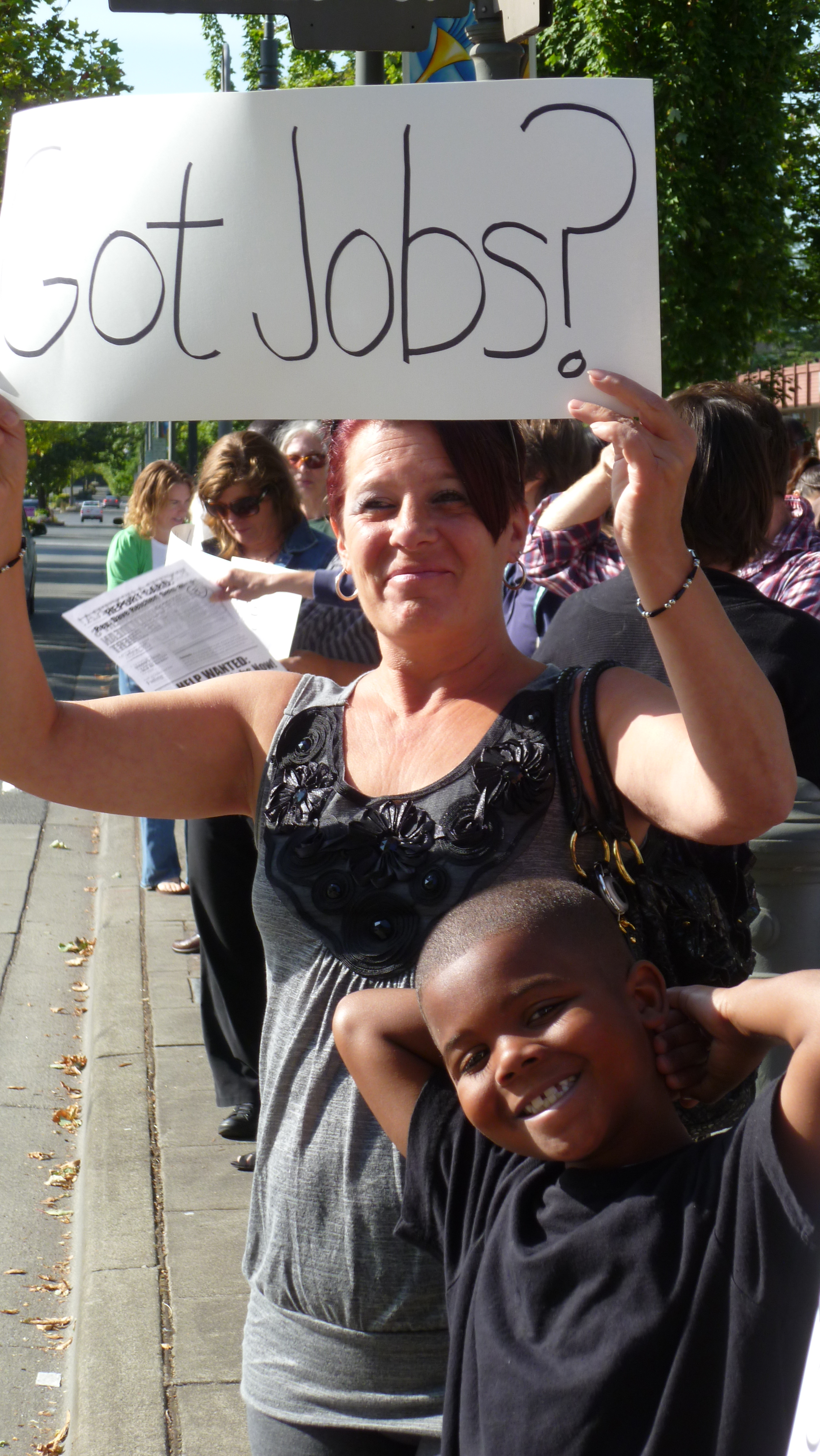
Woman holding "Got Jobs?" sign No more bonuses. No more bailouts. No more tax breaks.

We've had enough. And on Wednesday, Sept. 21st we are going to tell those big corporations and greedy CEO's that we're not going to take it anymore.

Join us up at the luxurious resort of Suncadia in Cle Elum for a full day of action culminating in a People's Summit. Find out more about the Showdown at Suncadia from our friends at Washington CAN.

Or, join us in downtown Seattle at Chase bank's regional headquarters for some street theater. The way Chase treats us is criminal, and we'll visit one of the scenes of the crime to prove it.

Meet us at noon at Chase Bank, 1301 2nd Ave., downtown Seattle.

Click here to sign up!


Tay Yoshitani and the Port of Poverty

By Nate Jackson The latest census data confirmed what we already know; the lack of good jobs is driving more people into poverty. One out of every six people now live below the poverty line of $20,000 per year for a family of four.

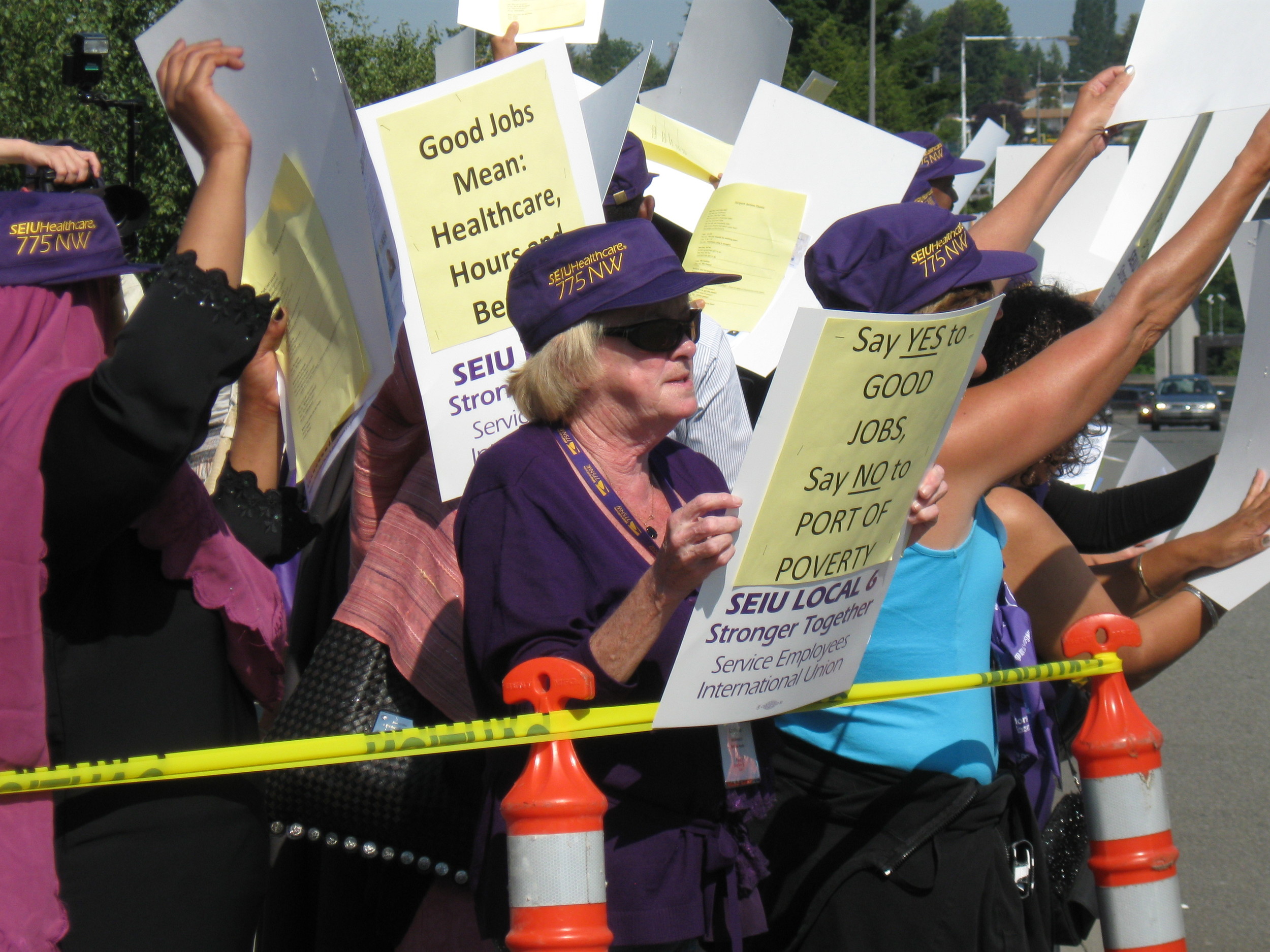
Working families gathered in the shadow of the Westin Hotel on Thursday, September 15th to protest the lack of good jobs at the Port of Seattle. Many of the workers at the port are making minimum wage, paid by the hour but with access to fewer and fewer hours of work. Meanwhile, Port of Seattle CEO Tay Yoshitani received a pay raise at taxpayer expense—he is now one of the highest paid port officials in the country.

Yoshitani calls his domain the “Port of Prosperity.” We call it the “Port of Poverty and Pollution.” Air pollution from dirty diesel torments neighborhoods, and the port’s working families are denied a living wage.

Josh Johnson, a young African-American man looking for work, came to the rally because he was confused about the priorities of the Port of Seattle.

“I thought the port was supposed to be about good jobs,” he said. “It’s terrible that Yoshitani is making $400 grand during this recession when some people can’t even find a decent job.”

Here in Washington State, our rate of poverty is a shocking 12 percent, but the real story behind the numbers is that the increasing poverty rate is caused by policy choices by businesses and politicians. People have been laid off and foreclosed on, banks aren’t lending and businesses aren’t hiring. Yet CEOs are still getting big bonuses and banks are making record profits. The rising poverty rates are happening on purpose, and we know exactly who to blame.

Hosea Wilcox has worked as a skycap for over 30 years. He has seen his wages and hours cut and he talked about how he can’t get any respect from his employer at the port.

“I’m ashamed to tell my children and my grandchildren that I make minimum wage,” Hosea said. “I’m on welfare because they don’t show any of us any respect. I deserve respect.”

Hosea is not alone. Working Families across the country have seen their actual income fall over the past ten years and we make less now than we did in the 1990’s.

Instead of providing good jobs and security for their workers, most of the wealth is handed out to the few. Tay Yoshitani, a public official, raked in nearly $400,000 dollars in 2010, that’s almost twice as much as the governor, while many of the positions at the ports make minimum wage. We’ve allowed them to dole out our tax dollars to CEOs who are supposed to be working for us. We’re sick of it.

Norm Conrad, a retiree who has been forced back into work, wasn’t surprised that the public CEO made so much money.

“Yoshitani should be ashamed of himself,” he said.

It’s time for us to come together and fight back. We can’t just let CEOs like Yoshitani live the high life while working families can’t even afford food and shelter. We need to hold the big corporations and greedy CEOs accountable for their failure to create good jobs here in Washington State.

Too many of us have stared poverty in the face, and we know that it is something to be scared of. So let’s give the CEOs something else to be scared of – our unrelenting demand for justice. No more bonuses, no more bailouts, no more tax breaks. It’s time for justice.

White House Talks to Us about the Jobs Act

By Sandra VanderVen There’s a lot going wrong in politics today, no one would dispute. The good news is that in some cases, the challenges we face are being met with creativity and verve. One instance is the way the White House is engaging states to help pass the proposed Jobs Act.

It doesn’t make sense at first glance—isn’t it Congress’ job to pass this?  What do the states have to do with it? Experience tells us it won’t work to just sit back and wait for Congress to act on the will of the people. If we don’t pressure them to pass it, they’ll end up listening again to the corporate lobbyists who got us here in the first place.

Let’s make sure we know what we’re fighting for. Here are some tidbits from this fact sheet.

  • Washington state will receive $365,100,000 in funding to support as many as 4,700 school improvement jobs.
  • This act will provide $627,800,000 in funds to Washington to support up to 8,500 educator and first responder jobs.
  • The President’s plan will make immediate investments of at least $741,100,000 in Washington that could support a minimum of approximately 9,600 local construction jobs, while improving infrastructure.

Brad Jenkins, the Associate Director of the White House Office of Public Engagement, realizes this.  “The only way that we see the president able to push Congress to get this passed is through your work, educating communities on things that matter, and mobilizing.” It is up to groups like Working Washington and MoveOn.org and many other organizations to let people know what the jobs bill will do for us, and then it is up to us to join together to push our members of congress to pass it.

There are things we can do that will make a big difference.  We can influence the public, the media, and our elected officials if we lift our voices.  Consider writing a letter to the editor of your local newspaper. Email or call members of congress. Turn out to show strength in numbers when you hear of a MoveOn or Working Washington event. Talk to your neighbors.

The work we did during the August congressional recess-- calling out Members of Congress at town halls or even when they refused to appear in public--was heard loud and clear in the other Washington (DC).

The truth is that many Members of Congress are going to vote up or down only if their biggest donors will permit them to. It is up to us to make sure they add one more factor to their calculations: the anger of their constituents.


Work that Needs Doing

With millions unemployed across the country -- hundreds of thousands in the state of Washington-- we need to get people back to work. Luckily, there's lots of work that needs doing:

Look around. In virtually every community you’ll see work that needs doing. Rundown schools. Crumbling bridges. Neglected parks, recreation centers, and playgrounds. Buildings that need to be more energy efficient. Energy sources that need to be more environment-friendly.

WORK THAT NEEDS DOING is a project designed to bring these pictures to light. With the support of community, labor, and advocacy organizations from coast to coast, we’re gathering photos of work that needs doing and making sure our nation’s policymakers and elected officials see them.

Our mission is to put America back to work repairing our infrastructure and meeting our education, healthcare, and clean energy needs. Not only will it give our economy and middle class a desperately-needed boost, but it’s the only way to reduce the deficit in the long run.

So let's prove there's plenty of work that needs doing. Take some photos and upload them to the Work That Needs Doing website.

Seattle approves paid sick-leave requirement

By LYNN THOMPSON Seattle Times staff reporter

To loud cheers from hundreds of supporters, the Seattle City Council on Monday agreed to require businesses with at least five employees to provide paid sick leave to workers.

Seattle becomes just the third city in the country, after San Francisco and Washington, D.C., to mandate paid leave for employees to care for themselves or family members when ill. The state of Connecticut also has approved mandatory paid sick leave.

Read the entire story here: Seattle approves paid sick-leave requirement

Stories from the Port of Poverty

By Sage Wilson When 600 workers and community allies rallied at Sea-Tac airport on September 10th, it made quite a scene. We got noticed by travelers, by airport management, by reporters, and by other airport workers who were just doing their jobs that day.

When I arrived at the airport just as the rally was about to get underway, I overheard one worker who was checking bags look up from the task at hand for a moment to ask a co-worker: “Look at all those people — do you know what that’s about?”


“Yeah,” the second worker replied. “It’s about us.”

He's exactly right.

The rally was about us and every other airport worker, airport neighbor, and community member — because everyone has a stake in what kind of jobs are created at our airport. After all, Sea-Tac Airport is owned and operated by the Port of Seattle, a public agency whose official mission is to generate economic development and create jobs.

At the rally, we heard from a lot of people having problems with their employers at the airport. We heard workers who handle baggage, drive vans, push wheelchairs, and provide other services speak out about jobs that pay as little at $8.67 an hour with no health benefits. About jobs that don’t offer enough hours to make ends meet. And about bosses who hand out unfair discipline to workers who don’t have a voice. We even heard outrageous stories about people being denied employment on the basis of their religion or ethnic background.

KOMO news interviewed one of the skycaps who has been working at Sea-Tac for 30 years and still makes only minimum wage.

That’s why together, we call on Port of Seattle CEO Tay Yoshitani to change direction, live up to the mission and create good jobs. CEO Yoshitani certainly knows what a good job is, because he has one. He got a 9 percent raise this year, boosting his pay to nearly $400,000, making him one of the highest paid port officials in the country.

Now it’s up to the Port to do what it can to support good jobs for all workers — not just its CEO.