Hundreds of living wage jobs are at stake at Seattle's Hilton and Westin. Read more here about the situation and how you can get involved.
Outrageous water bills in New Holly
Aug. 24, 2011 By Sandra VanderVen
New Holly, Wash.—Recently, Dionna Fry of Working Washington was talking with residents of New Holly, when she unexpectedly got an earful.
They told her jobs are scarcer than ever. School bus routes have been cut for all kids who live within a mile of the school, even elementary.
Imagine how a working person without a car can provide transportation for a kindergartener when the school is a mile away?
But the biggest issue on their minds by far is one of the most precious resources we often take for granted: water.
The Seattle Housing Authority recognizes that people in low income housing struggle with water bills, so the plan is to ask residents who qualify for help to pay about 30 to 40 percent of their bill.
It turns out that this is not happening. Rather than paying for only a third of their bill, residents are paying about 75 percent of the total cost—which makes water worth its weight in gold, relatively.
It gets worse for New Holly residents like Beverly Riley, who has lived in the neighborhood for 35 years, at one time with three daughters. Riley said her ex-husband refused to pay child support in her early days of living there, but the water bills are harder to manage than those tight budget days.
“Now my water bill runs up to $150 every two months,” said Riley, 78. “I don’t use that much. I have arthritis and I have to get in the tub and soak.”
Recently, her water bill came in at $249. It turned out that her toilet had a silent leak. The housing authority let her pay the bill over two months—but that didn’t reduce the bill. She paid for the extra cost—and for fixing the toilet—with the $725 per month she receives from Social Security.
The reason many bills are high is there is a large amount of water pressure entering that neighborhood.
Generally, it is easy to regulate the amount of pressure entering a home when it is an average amount. This is important because high water pressure in a house is like high blood pressure in a human—it wears out the plumbing.
But that isn’t being addressed in New Holly, and instead, leaks are springing up. When the residents can’t find the leak, they have to pay the price.
New Holly residents have had a series of meetings with the Seattle Housing Authority to discuss this. The representatives of the Housing Authority claim residents use too much water.
Riley speaks to this issue too. “I know some people abused it by watering their gardens and filling little wading pools,” she said.
Hearing her say this is painful, when having a garden and giving the kids a way to cool off in the summer looks to some like a stolen luxury, while much of the water they are paying for is going down the drain from a leaky system they have no control over.
If society is judged by how we treat the most vulnerable, how are we doing in New Holly?
We Wanted your Jobs Ideas...
and You Delivered!
by Nate Jackson
The economy is working for CEOs and greedy corporations. They got bailouts and tax breaks, but for the rest of us, the officials who voted for tax cuts for the rich just don’t seem to realize that we need good jobs.
Since these “leaders” are too busy to look for answers to the jobs crisis, we asked you to give us your ideas about how to get this economy back on track. As expected, the ongoing results are fantastic, and we are still looking for more.
We asked you: “If you had a billion dollars, what jobs would you create?”
The results are pouring in and the vast majority of us have great ideas on how to get this economy moving again with practical, simple to implement ideas. In no particular order, let’s look at some of the ideas.
1. Marita G. suggests creating and funding art-based educational programs for children.
The impact on a community would be twofold: the positive influences of art in children’s lives and the good rewarding jobs created by the program itself. According to the Policy and Advocacy group ArtsUSA, some of the most impressive benefits are: equalizing the playing field for socio-economic differences, strengthening critical thinking skills and providing motivation for children to be continual learners.
Teaching is a highly rewarding career, and having specific programs to focus solely on art is very much needed when school district budgets are being cut. Often times, the arts are first on the chopping block during a budget crisis.
2. Harriet W. suggests building and running pet care centers.
Pet ownership is huge in the United States. According to The Humane Society 39% of US households own a dog, while 33 percent of households own a cat. If you broaden out to any pet the number of households in the USA that have a companion animal of some sort jumps to a majority 62 percent of households.
That is a huge market for business, and the pet industry is a multibillion dollar enterprise. Harriet’s idea of building and running pet centers is good because of the sheer potential number of customers. The pet care industry would create many jobs both in direct care and in support. Veterinarians and Vet Technicians would be needed to fill these positions and they are highly skilled professionals.
3. Quenea P. suggests: building and running low income area grocery stores.
Many people in low income areas do not have readily available nutritious foods to eat. Some of these areas do not have a grocery store, which is called the “food desert” phenomenon. Fast food restaurants and gas stations stock greasy, salty and fatty foods that negatively impact the community’s health and longevity.
Stores in low income areas would not only alleviate the “food desert” syndrome, but would activate a job creation center. Grocery stores may not have the largest profit margins, but they are steady and reliable. Grocery jobs, under the proper conditions, are good work that is stable. Stable employment is one of the best ways to get this economy moving again.
These jobs would help fulfill First Lady Michelle Obama’s fight against childhood obesity.
4. Chris W. suggests: Construct mixed income housing near job centers.
Construction jobs are good jobs for families. If you follow some of the examples that have already occurred in the Seattle area, these jobs can be quite stable.
Constructing homes that are near job centers creates walkable communities. Dependence on car-based transportation, a major social justice issue and sometimes impediment to gainful employment, would be lessened.
5. Sibyl J. suggests: Bringing back the Works Progress Administration (WPA) and the Citizen’s Conservation Core (CCC).
These two organizations are “New Deal” programs that put young people to work during and after the Great Depression. The “New Deal” created infrastructure, parks, and other major public works projects. Some of our country’s greatest projects, like the Federal Writer’s Project that employed writers and artists.
A similar type of program might look something like an expanded AmeriCorps program. AmeriCorps is the domestic, or United States based, version of Peace Corps. Participants choose from varying work from teaching, home building, environmental protection or various other community needs.
A version of rebuilding roads, bridges, parks and retrofitting buildings would create many good jobs with the potential to transfer those skills learned into the private sector upon completion of the program. Some estimates have the amount of crumbling roads and bridges in the thousands.
If you have an idea that you haven’t seen here please send us what you think would be the best use of a billion dollars for bringing good jobs back to Washington here: We Need a Jobs Idea from You.
Who We Are--Kim Garcia
Sherry Williams: Jobs She Would Create with $1 billion
This is What Democracy Looks Like!
We are so, so, so proud of the 200 people that came out to demand good jobs from Rep. Dave Reichert in his district. Watch as they rally:
CNN: Demands for Jobs Across the Country
CNN video We're building a movement--watch this video as people across the country demand good jobs.
Seattle Workers Stand Up for Themselves and Demand Good Jobs
by Julio Sanchez
Seattle--Thursday, Aug. 11, seven workers stood up to demand living wage jobs for themselves and their communities.
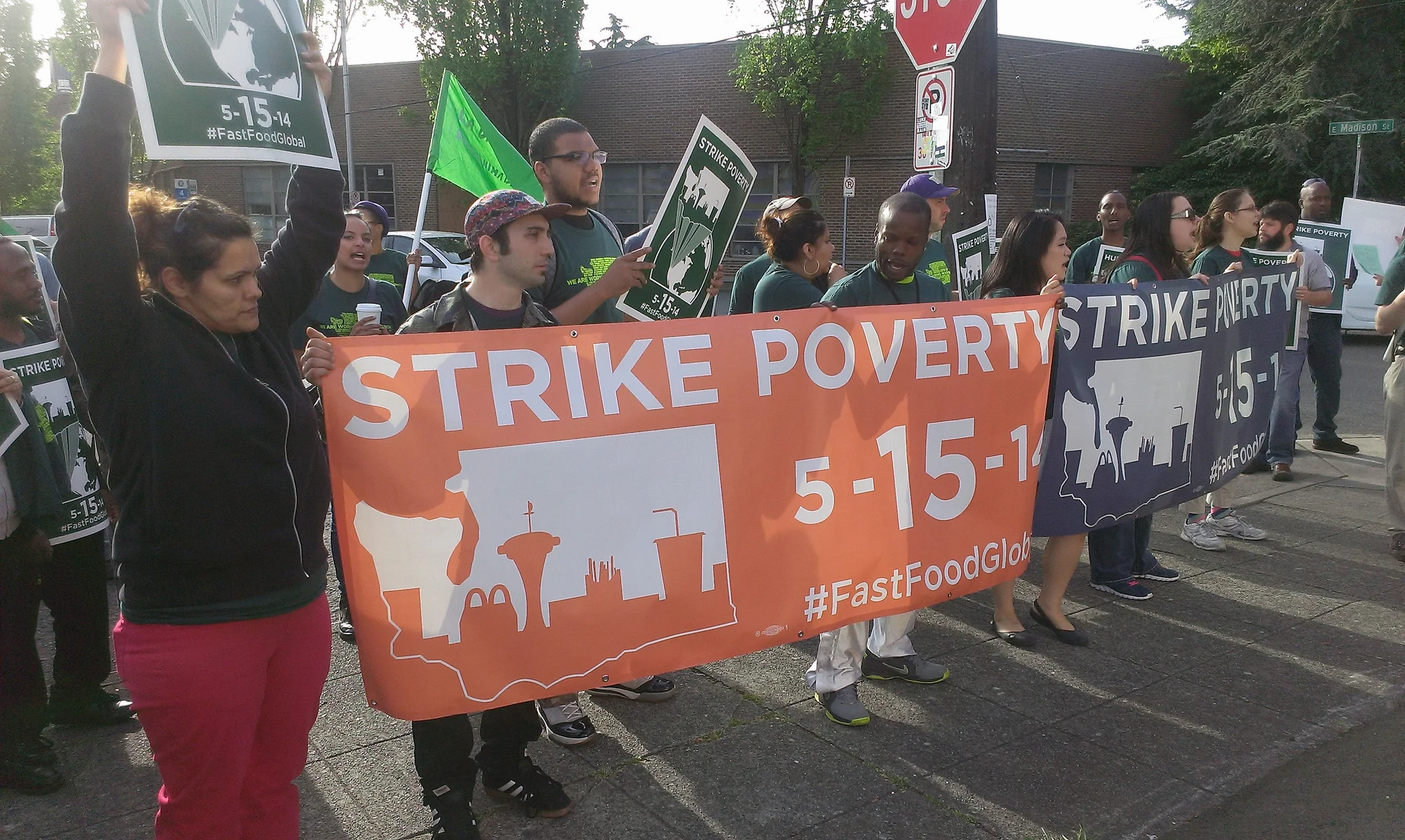
Workers in Seattle are speaking up to private business, local, state and federal officials demanding good jobs. After years of unprecedented tax breaks for the rich and greedy corporations, the results are record breaking profits for those that make the most, but very few living wage jobs for us.
Kimberly, Vernon, Frank and others went to a city-funded construction site and the Park and Recreations Services office in Seattle moved by the lack of steady, living wage jobs and the effect this is having in our communities.
Working Washington went with workers Kimberly, Vernon and Frank and Ed to a Lake City construction site to demand that jobs funded by money from our community be offered to qualified unemployed community members. Ed, one of the workers, read a letter stating that we are ready and able to work and demanded the opportunity to compete for this jobs.
Next we moved on to the Park and Recreations services office in Seattle. This is the city department in charge of the Ranier Beach Community Center construction project.
The center is closed at present and the project has not been granted to any contractors yet. This project was chosen because, by closing the center, this has left a hole in the fabric of the community. Again, we asked that that good jobs that come out of the project be offered to qualified community members.
In a letter read to a city official, Vernon said, ”We are asking for a fair shot at the jobs created in our communities.”
Frank added that the actions are not over yet, and they can expect to see more of us demanding good jobs. With Congress continuing to grant tax breaks to the rich instead of helping create jobs for the middle class, our fight will continue.
“We are going to keep coming back until our voices are heard,” Frank said.
Washington Teamsters Plan to Leaflet 50 Fred Meyer and QFC Stores
Leafleting to take place statewide over the weekend (Tukwila, WA) Teamster grocery warehouse workers, their families, and community allies will handbill 50 Fred Meyer and QFC stores this weekend, demanding that the stores’ parent company, Kroger, provide its workers and their families with quality, affordable health care coverage.
Kroger reported over $432 million in profits in the first quarter of 2011, an increase of 16%. Its CEO, David Dillon, has been paid over $25 million in the last five years. Yet despite soaring profits, Kroger refuses in bargaining to provide Teamster grocery workers at the Fred Meyer distribution center in Puyallup with the same health care coverage as other workers in the industry, and instead has initiated a campaign to undermine the collective bargaining process.
WHO:
Tracey A. Thompson, Teamsters Local 117 - Secretary Treasurer
Fred Meyer grocery warehouse workers and their family members
WHAT/WHEN:
FRED MEYER/QFC LEAFLETING ACTION
Saturday, August 20 / Sunday, August 21
11 A.M.
WHERE:
Fred Meyer Parking Lot
1100 North Meridian, Puyallup, WA 98371
Immigrants, Constituents Ask Rep. Smith for Good Jobs
by Sara Kiesler Update: See the Adam Smith "Speak Out" video
Des Moines, Wash.--About 170 people came to Rep. Adam Smith in the 9th congressional district Monday to ask him to bring back a message of good jobs to Congress.
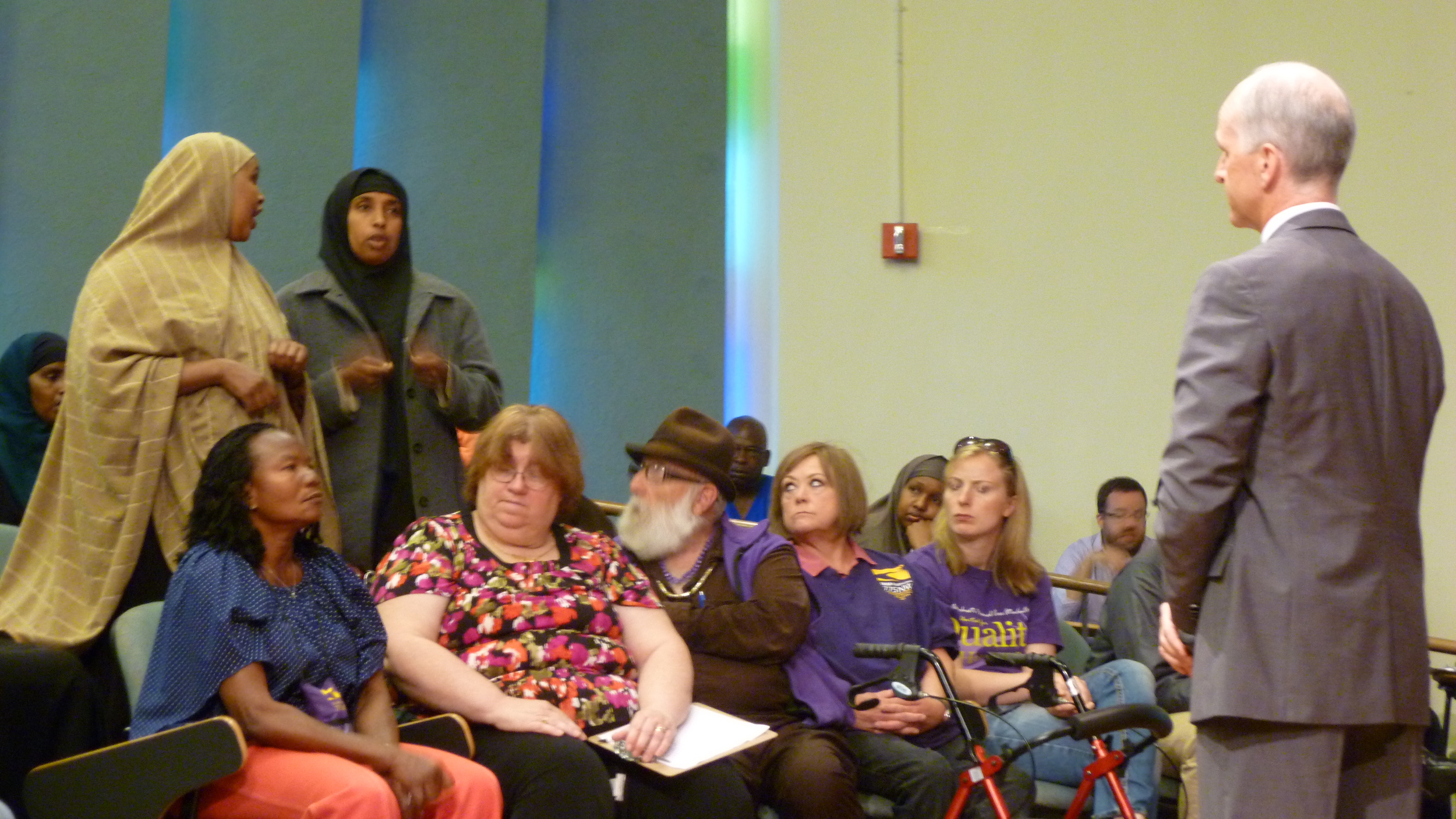
The large group, comprised of a variety of backgrounds including Somalian, Bhutanese and Mexican immigrants, filled the Highline Community College auditorium in Des Moines. Many of the people attending were out of work or looking for more work, and came ready to share stories of how the economic crisis is affecting their families.
Kim Garcia, a construction worker that was formerly in the military, said when she lost her job in 2009, things took a downward spiral and she now may lose her home. Her 18-year-old son has recently joined the military because he cannot find a job either.
“We don’t see a bailout for us,” she said, referring to the government’s Big Bank bailouts, such as the $100 billion that went to mega-profit making Chase Bank.
The “Speak Out for Good Jobs” event is part of an ongoing series during the August Recess in which Washingtonians are reminding Congress that good jobs are vital to keep America moving forward.
David R. Lindberg, a cargiver, shared a message heard over and over this month--that the recession may be over for the rich, but what about the rest of us?
“We need to re-establish the American Dream,” he said. “The only way to do that is to end tax loopholes and create jobs.”
Rep. Smith (D-WA) reflected on the access his family had to the American Dream.
“My father was in a labor union, and when he died, my family had enough support to keep going,” he said. “There’s a lot more we can do to protect jobs in the US.”
He responded to many of the constituents concerns and encouraged them to keep contacting their representatives.
At the end of the day, emcee and Washington state Rep. Dave Upthegrove (D-33) looked out over the crowd of diverse faces and congratulated everyone for speaking up for good jobs.
“The Tea Party ain’t got nothing on us,” he said.