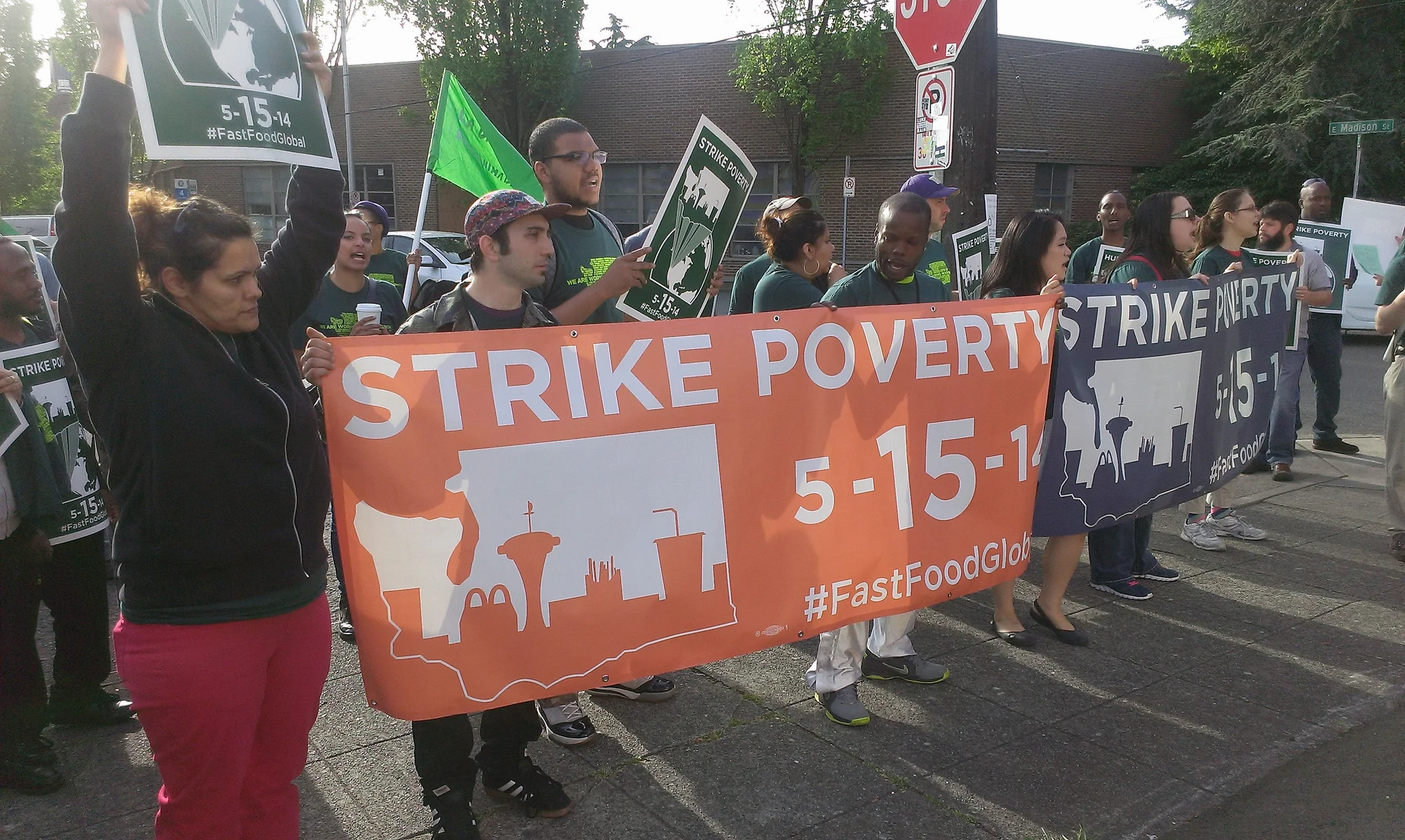
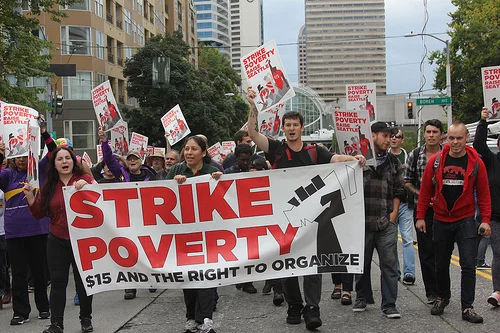
Seattle joined over 50 cities across the country and went out on strike for better pay and the right to organize without retaliation for low-wage workers. Fast food workers walked off, Baristas walked off, community members marched, and the city couldn't take their eyes away.


We're walking out on August 29th. Join us.
We work at fast food chains and other low-wage jobs and we deserve better. That’s why we’re joining with thousands of other workers from New York to Chicago and beyond to call on low-wage workers across the country to walk off the job on August 29th.
We’re going on strike to improve conditions for all workers because everyone deserves a basic standard of $15/hour and the right to organize without retaliation.
We’re going on strike because even though we work at different chains, we face many of the same struggles: low pay, not enough hours, unfair treatment, and even wage theft.
We’re going on strike because we deserve opportunities for a better future.
We’re going on strike because something is seriously wrong when the fastest-growing jobs pay poverty wages.
We’re going on strike because it’s not right that some of the largest and most profitable corporations around pay some of the lowest wages.
We’re going on strike because nothing is going to change if workers like us don’t lead the way forward.
Turn off the fryers. Take off your aprons. Walk out, and join us August 29th on the strikelines.
Worker Power
What a week of worker power!
You probably saw fast food and coffee workers standing up against wage theft on TV, but if ya missed it in person, we got you covered.
Check out our YouTube video "Make Them Pay" - it's a little bonus footage of the week of worker lead actions against wage theft.
Fast food and coffee workers protested against wage theft from North Seattle all the way down to SoDo. Workers then came back together in downtown Seattle for a massive rally that ended with some workers linking arms and engaging in peaceful civil disobedience over the issues of low pay and CRIMINAL wage theft.
Wage Theft is a CRIME. Make them pay.
This THURSDAY, August 1st, 4:15pm at Westlake Park.
Fast food restaurants are stealing money from the paychecks of poverty wage workers - as much as $100,000 a week in Seattle alone.
This wage theft crime scene includes:
Forced to work off the clock Unpaid breaks Not paid time and a half for overtime Subminimum wages
SeaTac Voters Celebrate Good Jobs Initiative Moving On To Fall Ballot
Alaska Airlines, WA Restaurant Association failed to stop SeaTac City Council from sending living wage, paid sick leave to voters
SeaTac – July 23, 2013: More than 250 SeaTac voters, airport workers, and supporters celebrated the City Council’s unanimous vote to send the Good Jobs Initiative to voters later this fall. Earlier in the evening supporters had joyfully paraded from a nearby park to the SeaTac City Hall, where council members then took public testimony and performed a procedural vote to send the initiative to the fall ballot.
Corporate lawyers for Alaska Airlines and the Washington Restaurant Association failed to block today’s SeaTac City Council vote, despite filing a last second lawsuit in King County Superior Court and a challenge to the petition signatures. Alaska Airlines lost both attempts.
Residents, airport workers and service providers provided compelling testimony that Good Jobs will make SeaTac a better place to work and to do business (full testimony available upon request):
“A lot of my clients work at the airport for companies that contract to the big airlines, like Menzies, DGS, Airserve, and FSS. They all live in the SeaTac, Tukwila, Burien area. Most of them work for minimum wage. Some have been there for 2, 3 years still making $10 or so. Most of the people who come in from the airport instantly qualify for public assistance because they are supporting at least one other person – a child, spouse, elderly parent,” testified Taffy Maene, Board President of the United Territories of Pacific Islands Alliance, who also works as a public assistance provider.
“My students are part of families who are working local jobs… Without well-paying jobs they leave. The housing situation is particularly vital in establishing stability for these families. You are less likely to move away if you have a solid paying job in your own community,” testified Luis Escamillia, a local high school teacher and resident of SeaTac.
“I don’t have paid sick leave. If I have an emergency I have to take unpaid time off. If I take too much time off I’ll get fired. My husband works cleaning rooms at the downtown Westin Hotel even though he is old enough to retire. He keeps working so we can have health care. If my husband retires or if something happens, I won’t get my pills for my thyroid condition,” testified Evelyn Orlano, an airport worker who works two part-time jobs at the airport for minimum wage.
“When the Good Jobs Initiative passes, I won’t have to work so much overtime to make rent and I’ll have more time to spend with my daughter. I’ll be able to be a better dad,” testified Socrates Bravo, an airport worker who lives in a SeaTac apartment with another airport worker.
“A few years ago I worked as a short order cook at the Denny’s across the street. I’d work at Denny’s 7am – 2:45pm, take a quick sponge bath in the bathroom, brush my teeth, apply deodorant, then put on my bellman uniform and work from 3 – 11pm. If I have to get a second job to make ends meet on my minimum wage and tips, I wonder how employees at other hotels survive when those corporations are keeping their service charges and tips?” testified Tim Doherty, who has worked for 25 years as bellman at the Hilton Doubletree in SeaTac and is currently applying for a second, part-time job.
“I think the Good Jobs Initiative will make the City of SeaTac a better place to do business. That’s because more of the people shopping and living here will have more money to spend here in our shops,” testified SeaTac small business owner, Abdifatah Haashin.
“My hope is that with a livable wage our communities could be stabilized. Families could be under less stress. Parents would have time and the emotional availability to sit with their children, read to them, play with them, even attend school events with them – those things are missing in times of stress. My hope is that instead of a cup of noodles for breakfast or chips and soda for dinner - families could enjoy balanced meals that even contain vegetables,” testified Minister Jan Bolerjack, who runs the food pantry at the Riverton Park United Methodist Church.
The Good Jobs initiative, signed by more than 2,500 petitioners in SeaTac, provides targeted solutions for well-documented unfair working conditions at Sea-Tac Airport and in some of the larger airport-related businesses. (Alaska Airlines was recently punished withthousands in fines from the State Labor & Industries inspectors for allowing dangerous working conditions).
The SeaTac Good Jobs Initiative would bring Sea-Tac Airport in line with workforce standards already in effect at other west coast airports, as documented in the report Below the Radar issued in March 2013 by Puget Sound Sage.
The SeaTac Good Jobs Initiative would set basic employment standards for workers employed in the transportation, tourism and hospitality industries in SeaTac, including paid sick leave, full-time work for those who need it, a living wage of at least $15/hour, job security for employees when companies change contractors, and assurances that tips and service charges go to the workers who perform the service.
The measure would cover businesses in and around the airport, including airport baggage handling, passenger services, cabin cleaning, aircraft fueling, security, and retail stores, along with hotels, rental car and parking lot facilities. Small businesses and non-airport related businesses are specifically exempt.
###
Fast Food Workers Take #StrikePoverty to City Hall
Fast food workers and community allies filled city council chambers to give first-hand accounts about low pay, wage theft, health & safety violations and other issues affecting low wage workers in Seattle. https://storify.com/WorkingWa/fast-food-workers-talk-wage-and-health-violations
Mayoral candidates vie for low wage workers' votes
Six candidates for mayor of Seattle pulled green, circular stickers off of a small sheet. Each sticker represented $25 of a monthly budget, and the candidates had to stick them on an oversized poster board to show how they would make ends meet on the same amount of money a full-time minimum wage worker takes home per month — about $1200.
Try as they might, none of them could make it work without skipping bills, assuming they had no families, or as one candidate suggested, taking a second job on the side. And we only made them deal with the basics — stuff like housing, food, transportation, and child care.
This was how we began our Low-wage Workers Mayoral Town Hall, co-hosted by people who work in fast food and other fast-growing low-wage industries.
Our forum also included an education for candidates, in the form of a presentation by Lori Pfingst of the Budget & Policy Center about the rapid growth of low-wage jobs, income inequality, and other important economic trends.
The education continued with a panel of workers who shared their stories and got to ask the candidates the kinds of direct questions that they don’t normally have to answer:
-
Alfonso, who works at Taco Del Mar asked how the candidates would support workers struggling to make ends meet.
-
Tracie, from Safeway asked about how the candidates would keep low road employers like Walmart and Whole Foods from breaking down standards workers have already won.
-
Kellie, a child care provider asked what steps they would take to raise the pay and professionalism of early child education.
-
Aaron, who works at Burger King asked how the candidates would protect workers from wage theft, cut hours and pushing health care costs onto the public (employers cutting hours to get out of providing health care).
It’s rare that candidates for mayor have to answer questions directly from workers, but that’s exactly what happened on Saturday. And it only happened because the the enormous public support for the fast food strike showed these candidates for mayor that they needed to be ready to explain their plans to address the issues facing low-wage workers, just like they’re expected to have plans on other major issues like education and transportation.
So how did the candidates do? The forum was recorded by the Seattle Channel, so you’ll be able to watch and decide for yourself. KING-5 and some other media outlets also were there for to hear how the candidates responded to these issues — you can check out what they had to say about it right here.
Here’s something else that stood out. In their closing statements the candidates had to say what they’d do to lift up low-wage workers, and explain how they made their minimum-wage budgets.
One shook his head and stated “I’m assuming I’m a single person, with no kids, no significant other and am living outside of Seattle. Otherwise, I just can’t see this working. This, this is real. This was tough.”
Exactly.
Strike Poverty! Raise Seattle!--A wrap up in tweets, photos and video
Fast food workers launched strikes across the city for better pay and the right to organize without retaliation. Overwhelming community support is what met them as they walked off and back onto work the next day. Here are the highlights in Tweets, Photos, News Articles and Videos.
http://storify.com/WorkingWa/strike-poverty-raise-seattle
Seattle Fast Food Workers Are On Strike
Fast food workers have launched strikelines across the city today, forcing three restaurants to close as the workers walked out, echoing the national call for a living wage of $15 and the right to organize without retaliation.
While the top tier of Seattle's economy may be booming, thousands of us are being left behind. Even though companies we work for make millions in profits, fast food workers are paid so little that we can't even afford the basics— like food, rent, repairs, and taking care of our families.
Paying us a better wage will be better for our families and our futures. Better pay for workers like us also let us contribute more to the local economy, and that benefits everyone.
We're on strike today because we can't sustain our future — or Seattle's future — on poverty wage jobs.
At Doc Maynard's Low-Wage Workers Tell Their Stories
“I never used to understand my father,” Fermin said into the microphone. “He was always angry, cold, you know? It wasn’t until I grew up that I realized why. He was always working and it was killing him.” He looked around the full room at Doc Maynard’s Bar and gripped the microphone.
“He worked jobs like I do,” he said. “They don’t pay anything, barely anything and you have to work all the time just to make ends meet. It’s not right and we have to do something about it. I don’t want to turn out like he was in my childhood always tired, never smiling. I do want a family someday, but I can’t do that to them.”
Fermin works at a fast food company. He is paid poverty wages and lives in a small apartment. He has had to cut all his living expenses to the bone as his job pays him so little. He was sharing his story to a room full of community members who had all come out to show their support for workers in the crowded, darkened stage room of Doc Maynard’s, a downtown Seattle bar and tourist attraction.
“I want to be able to save money, go see a movie once in a while,” he said. “Sometimes I have to skip meals. How am I supposed to think about going back to school or anything like that? I just want to make enough to live the way I want to live.”
Workers across the country are starting to stand up. A few months ago, fast food workers from New York City walked off the job in a first of its kind one day strike. The facts are that 7 out of the 10 fastest growing jobs in the United States are low wage jobs.
There is no reason why these jobs need to pay so little or have such unpredictable and changeable hours.
It isn’t an isolated case that workers are standing up. The LA Times article “Fast-food workers walk out in N.Y. amid rising U.S. labor unrest” said:
“Those actions (New York Fast Food Strikes) follow a period of relative quiet on the labor front, broken by the Chicago teacher’s strike earlier this year and a strike by employees of Hostess Brands….more walkouts are likely to come.”
Sarah Jaffe, an independent journalist, was the MC for the event. She has written extensively about labor issues, workers’ rights and the Occupy Movement. She had also just written about the New York strike calling it “The McJobs Strike Back.” She welcomed the audience to the event and introduced the other speakers.
“I’ve never been a part of something like this,” she said standing on the stage. “But, I’m inspired by these workers who are telling it like it is. There’s something going on in this country and workers are making it happen. Let’s hear from them now.”
The other workers shared their stores while sitting on an elevated stage with microphones pinned to their shirts or blouses. They were from different jobs and different workplaces, but they all had something in common. They were taking action to change their workplaces for the better. They all wanted better wages and better treatment.
“I’m getting married,” Spencer said holding the microphone in a firm grip and looking out at the audience. “I don’t know how we are going to make it because I am paid such low wages. We can’t even think of starting a family. We wouldn’t be able to afford it. That’s why I’m doing something about it. My co-workers and I have formed a Union. We’re standing up together.”
Spencer works for a low wage airport contractor at Sea-Tac Airport. He handles the baggage driving the trucks and loading and unloading the luggage of Alaska Airlines’ passengers. It is fast paced; harried and thankless work and for all their efforts they are paid poverty wages.
“We marched on our managers,” Spencer said. “Too many of us have been working scared—scared for our safety, scared of our bills, scared of saying anything. Not anymore. We need better wages and a safer workplace. And we are going to make it happen.”
Pancho, speaking through a translator, talked about his work in a fast food restaurant. He has been working at the same location doing the same work for nearly three years and he hasn’t seen his wages go up except when minimum wage has.
“I work hard,” he said becoming more animated as he clutched the microphone. “I’m taking care of my family back in Mexico and this pay; it just doesn’t. I have two daughters and I’m worried about them.”
Pancho talked about how when he first got hired at the job the managers told him that if he increased his skills and undertook on the job training they would increase his wages. He has learned new skills, mastering the machines, learning food prep skills and even taking more responsibility at work across different job types. His pay hasn’t risen.
“I learned all the things they wanted me to learn,” he said. “I learned to cook, to clean, to work the machines. I do the work of two people and I still make minimum wage.”
He paused to let the translator catch up.
“I’ve been on the job for three years,” he said. “This industry just cuts corners. They don’t hire enough people; they don’t pay enough wages and I have to do something about it.”
Wilton is a fast food worker from New York. He took place in the historic fast food worker strike a month before. He joined hundreds of other workers taking their message to the street and he came out to Seattle to give encouragement to workers who are fed up with low wages and poor treatment.
“I’m a cook,” he said. “I’m a good cook. People say I’m the best one there. But, I can’t survive on the paychecks they give me. I went on strike for my family. I deserve better pay—a living wage.”
Wilton looked around the stage.
“I work seven days a week,” he said. “I have to just to make enough to make it, but it still is not enough. I don’t get to see my family or hug my children. I want a living wage so that I don’t have to work seven days a week. That’s why I went on strike. That’s why I’m out here. Thank you.”
A recent study from the Chicago Federal Reserve Bank found that minimum wage increases raise incomes and increase consumer spending. The authors examine 23 years of household spending data and find that for every dollar increase for a minimum wage worker results in $2,800 in new consumer spending by his or her household over the following year.
When workers get paid more they are much more likely to turn around and put that money back into the community, lifting up local businesses and supporting other jobs.
It just makes sense.
Brittany took a deep breath and grabbed the microphone.
“I’m Brittany,” she said. “I work at Walmart. I’m a single mom and I take care of my two year old son. Because of Walmart’s pay and hours I’m still living at home. I want to move on.”
She paused looking around the room. The audience clapped encouraging her to continue.
“I used to get decent hours,” she said. “I mean the pay was always bad, but the hours were decent. But, they’ve been cutting hours so much and trying to make excuses. They say that sales are down, but it’s not true. Stop making excuses Walmart. You just don’t want to pay us a decent wage.”
She shook her head.
“They keep cutting hours and then hire people,” she said. “It doesn’t make sense, ya know? So I joined OUR Walmart, a group of associates who are working together to make Walmart pay us a decent wage and give us enough hours.”
Brittany stopped and smiled.
“I want to be a kindergarten teacher someday,” she said. “I just want decent pay and pretty good hours so I can make those plans come true. I don’t want to be rich or anything, I just want enough so I can take the next step.”